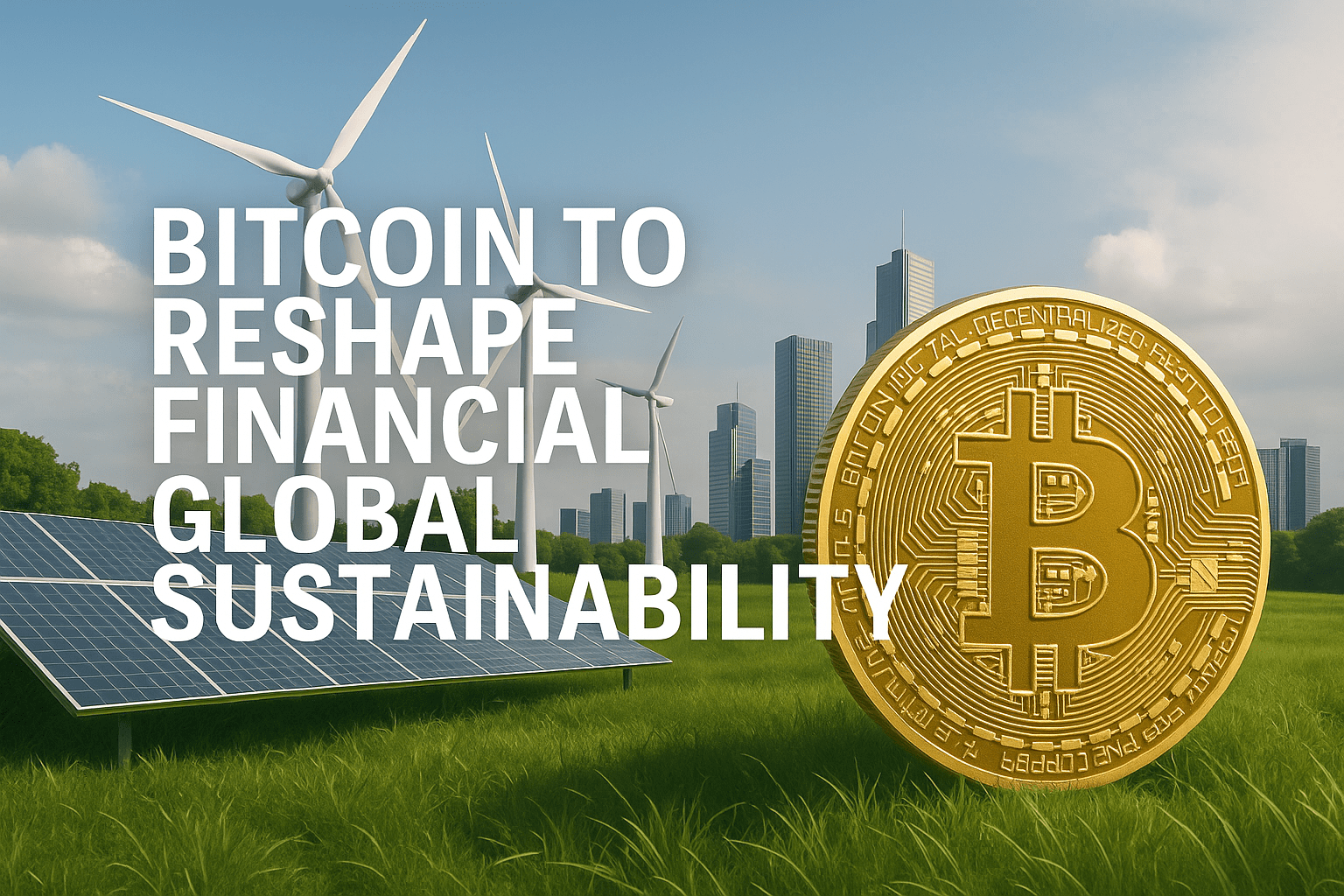
Prioritize Environmental, Social, and Governance (ESG) goals. Do so by applying a near-infinite number of ad-hoc tools which vary from country to country and region to region. Do it with a fractured financial infrastructure, and of course, try to achieve economic growth throughout.
There’s another possibility. Pursue ESG goals within a unified framework with clearly identifiable goals. Do it all under the advantage of a financial instrument that allows for various applications but can contribute towards the overarching goals.
Here’s how Bitcoin could reshape global finance and improve sustainability, allowing innovation from the ground up.
ESG goals have become a dominant theme in national and corporate economics. The EU, for example, has many ESG-related rules on the books:
All told, the report concludes that there are significant chances for Bitcoin to actually support ESG initiatives and the UN’s own SDGs, contrary to the common perception of Bitcoin being in opposition to such goals.
Of course, there is one particularly thorny environmental issue with Bitcoin that’s well-known: energy consumption. There may be a path forward for Bitcoin there as well.
One of the primary arguments against Bitcoin has been that it is fundamentally environmentally unfriendly, consuming far too much energy that could otherwise go towards supplying business and infrastructure.
Understanding how Bitcoin energy consumption could be helpful to starts with understanding that not all energy is created equal. Energy from renewable sources impacts the environment in a radically different way than gas or coal-fired electricity.
Understanding the differentiated nature of energy consumption, the Bitcoin Bundesverband report highlighted several potential uses for Bitcoin’s energy appetites.
These ideas fit into a broader trend of reconsidering Bitcoin mining in the light of expanding renewable energy production.
Renewable energy sources, such as wind and solar, can be unpredictable. Energy grids based on those sources tend to suffer from periodic underproduction (often offset by battery storage) and overproduction, during which excess energy may simply be lost.
By scaling up Bitcoin mining operations during overproduction and scaling them down in scarcity, Bitcoin’s proof-of-work model could actually contribute to stabilizing renewable energy networks and promoting decarbonization.
At the same time, it’s worth noting as the Bitcoin Bundesverband Report does, that the actual energy consumption of the Bitcoin network – approx. 146 TWh/year – is significantly less compared to traditional financial systems and gold mining.
The development of Bitcoin has completely changed over the past 5 years, most notably since Michael Saylor launched (Micro)Strategy’s famous pivot.
The combination is on the verge of completely transforming the financial framework to streamline ESG implementation.
Companies and governments are increasingly using Bitcoin as a strategic financial tool. It serves as:
Notable adopters include firms like MicroStrategy, Tesla, Deutsche Börse, and state-backed entities in Abu Dhabi, Bhutan, and Texas.
On the social side, Bitcoin is also transforming how projects raise funds. Instead of issuing new tokens, some initiatives use Bitcoin directly for crowdfunding, supported by fast, low-cost second-layer solutions like the Lightning Network.
Public administrations in countries like Estonia, Georgia, and Guatemala are using the Bitcoin blockchain to anchor official documents, securing them against tampering and enhancing trust in regions with fragile institutions.
This ‘digital notary’ function provides global verifiability for everything from land registries to election records.
Social and financial, corporate and individual – the Bitcoin Bundesverband Report highlights how transformative Bitcoin’s impact has become.
And now there’s a meme coin poised to take it one step further.
The result? An innovative project roadmap that rewards key Bitcoin milestones with either deflationary token burns or free crypto airdrops.
And if $BTC hits $250K? Then a truly massive $BTCBULL airdrop awaits.
This isn’t an independent project; it’s a meme coin fully integrated into the ever-more-integrated Bitcoin ecosystem. The tokenomics reflect that, with an even distribution between short-term and long-term goals.
ESG initiatives can be complex to evaluate. But the Bitcoin Bundesverband Report shows that Bitcoin doesn’t haven’t to be an obstacle to ESG; it can play a key role in advancing ESG goals.
And BTC Bull Token is right there with it.
As always, be sure to do your own research – this isn’t financial advice.