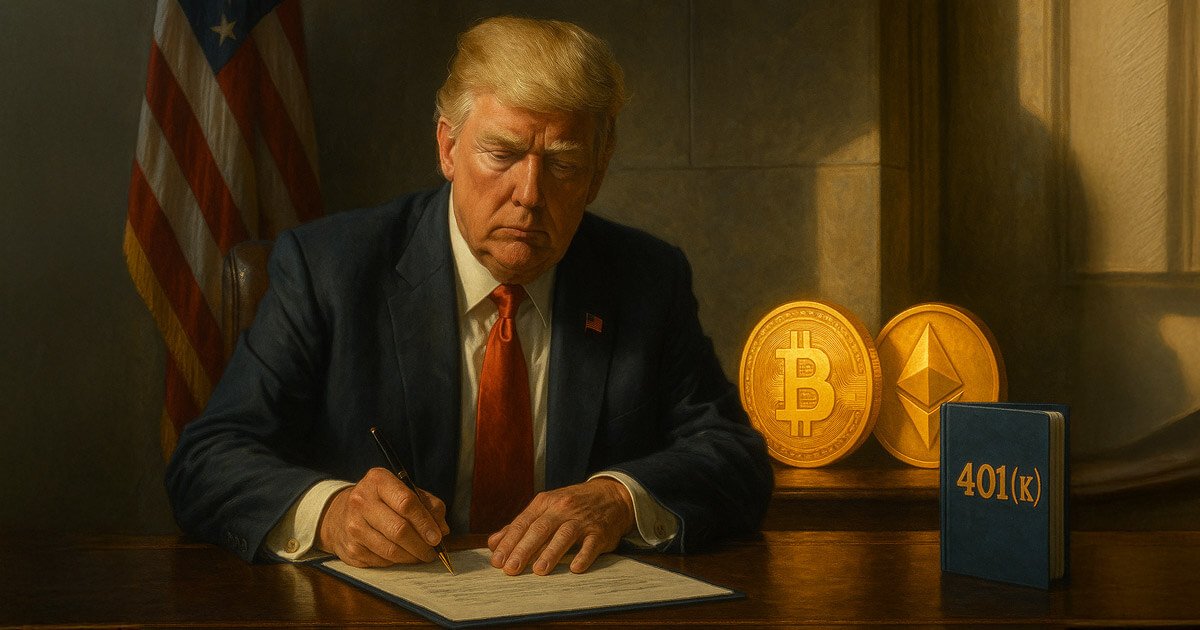
President Donald Trump will sign an executive order today directing federal regulators to ease legal pathways for 401(k) plans to include private equity, real estate, crypto, and other alternative assets.
The move positions approximately $12.5 trillion in U.S. retirement savings as a potential channel for asset managers long restricted from retail allocation pools. While traditional 401(k) plans remain concentrated in publicly traded equities and bonds, the administration’s directive would mark the most expansive policy shift yet to incorporate alternative assets, including digital currencies, into mainstream retirement products.
That earlier guidance diverged from ERISA’s principles-based approach, applying a more restrictive standard specifically to digital assets. With its removal, fiduciaries are once again directed to evaluate all assets, including crypto, under a consistent prudence standard rather than exceptional caution.
Institutional investors such as endowments and pension funds have increased exposure to these vehicles, while retail savers remain boxed into more limited instruments. Asset managers, facing allocation ceilings with institutional clients, see defined-contribution plans as the next frontier.
This latest directive mirrors actions taken during Trump’s first term, when the Labor Department allowed retirement plan administrators to include private equity in diversified investment options without violating fiduciary duty.
That guidance was rolled back under President Joe Biden’s administration before being reinstated through this new initiative. Per Bloomberg, legal concerns and fear of fiduciary liability had previously deterred plan sponsors from offering illiquid or complex products, but the current policy aims to formalize a framework that reduces perceived compliance risks.
For crypto in particular, the order sets the stage for formal inclusion into investment lineups that were until recently inaccessible due to regulatory opposition. Fiduciaries will still need to demonstrate adherence to ERISA’s prudence and duty-of-care standards, but without asset-specific disqualification. The implications include potential exposure to volatile, high-fee instruments by retail savers, placing renewed emphasis on disclosure, valuation methodologies, and custody safeguards.
The Department of Labor has indicated that it will coordinate with the SEC and other agencies to assess further rulemaking. The SEC is expected to take steps to facilitate crypto and private-market asset access for participant-directed plans. Meanwhile, firms such as Blackstone, Apollo, and KKR, which have long advocated for private market access to 401(k) funds, are positioned to benefit from first-mover infrastructure and lobbying investments.
Critics argue that complex assets may increase risk for savers lacking financial sophistication, particularly without robust oversight or transparent fee disclosures. However, supporters of the directive argue that fiduciary decisions, not categorical exclusions, should determine plan menus, and that savers should have access to the full range of modern capital instruments.
The executive order’s effect will depend on forthcoming implementation steps from federal agencies. For now, it establishes a policy marker that reorients the retirement system toward broader exposure to private and digital asset classes, marking another step in the administration’s ongoing integration of crypto into national economic infrastructure.