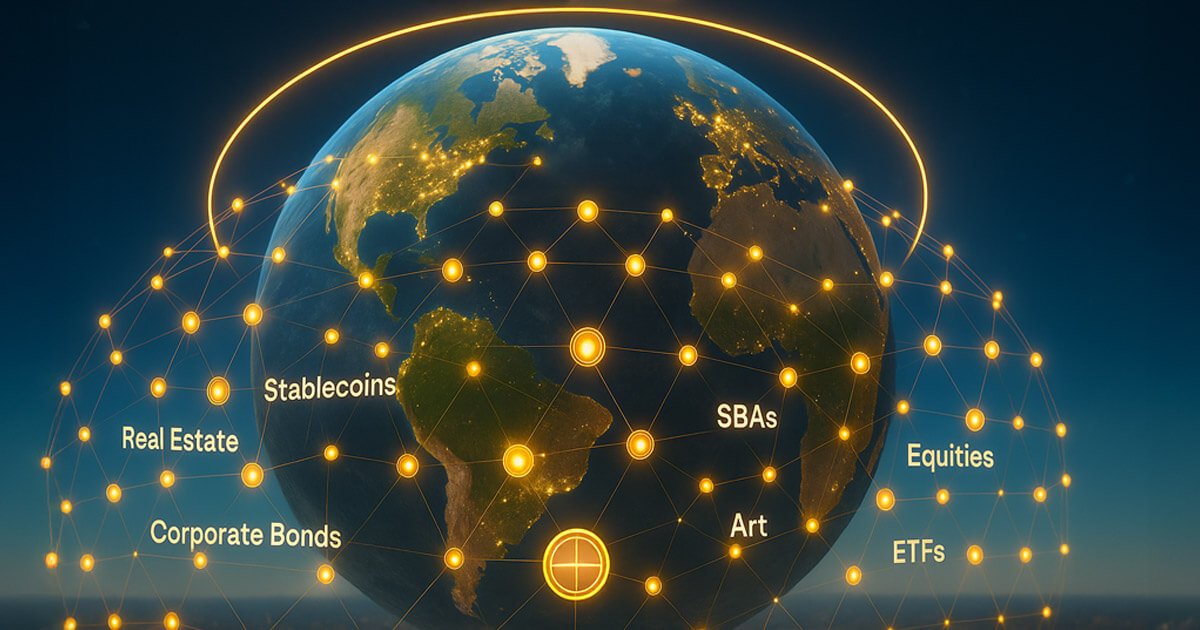
The figure, which includes stablecoins valued at about $266.7 billion, places tokenization near the $300 billion threshold, emphasizing its role as a structural layer in on-chain financial markets.
Excluding stablecoins, tokenized real-world assets account for around $26.3 billion.
The growth of tokenized U.S. Treasuries has emerged as a defining feature of this market. The segment surpassed $5 billion in March and now measures close to $7.3 billion in outstanding value.
BlackRock’s BUIDL fund represents the largest share, with roughly $2.4 billion, followed by Franklin Templeton’s BENJI, at about $700 million, while Ondo’s OUSG and other vehicles, including USYC, JTRSY, and USTB, round out the leading issuers.
This movement of short-term debt on the chain has accelerated in a high-interest-rate environment, drawing capital toward tokenized money-market funds and Treasury products.
Integrating BlackRock and Franklin into on-chain infrastructure illustrates how traditional finance firms use tokenization for capital markets operations beyond pilot programs. These tokenized funds function as yield-bearing stablecoin alternatives, attracting capital that may otherwise remain in non-interest-bearing stablecoin formats.
The diversification of tokenized assets beyond stablecoins highlights further adoption. Data shows smaller but steady issuance across private credit, institutional funds, commodities, and corporate debt instruments.
While Ethereum holds more than half of the non-stablecoin RWA share, networks such as ZKsync, Solana, Stellar, and Aptos are capturing portions of issuance, reflecting the infrastructure spread. These developments suggest tokenization is functioning as both a settlement infrastructure and a means of structuring regulated financial products on public ledgers.
While not all initiatives occur on public blockchains, the continued development of tokenized rails illustrates how traditional finance and crypto-native products are converging around the same operational mechanisms.
The distinction between stablecoins as transactional units and tokenized funds as yield-generating products will remain central to how investors allocate across these categories.
Tokenized assets approaching $300 billion marks a transition from concept to operating infrastructure.
The scale now reflects not only retail payments through stablecoins but also institutionally managed capital in regulated securities, suggesting that tokenization is already a live component of global financial plumbing rather than a speculative frontier.