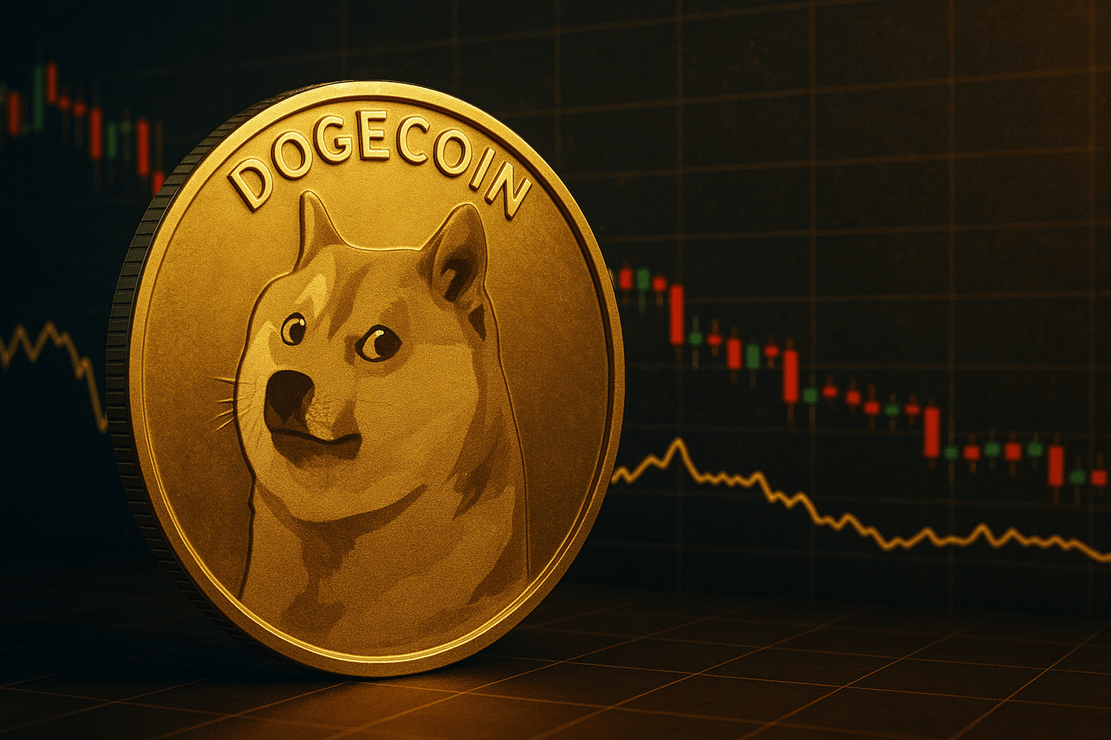
The Dogecoin question of the summer—whether the crash is finally over—met a hard-edged reality check in crypto analyst VisionPulsed’s August 20 video analysis. Stripping away “bullish propaganda,” he argued that Dogecoin will not meaningfully trend until two outside markers flip decisively risk-on: Ethereum crossing its all-time high and the Russell 2000 clearing its own peak. “We’re bearish until the Russell breaks the high and we’re bearish until ETH breaks the high,” he said, adding that the absence of those breakouts explains why familiar cycle cues have failed to ignite altcoins this time.
He framed that range as potential accumulation by analogy to prior long compressions, observing that earlier multi-month stalls preceded sharp expansions: “In the big picture, one would consider that to be bullish… This one was massive, like 400 days of sideways… we might even be [in] accumulation, if you will.”
The analyst’s core contention is that historical triggers that once synchronized altseason have broken down in this cycle. He revisited two now-faded playbooks: post-halving timed runs and the “BTC makes ATH → DOGE follows” sequence. “If we look at the halving… Dogecoin [historically] went to the moon about 240–260 days post-halving,” he said.
That sobriety extends beyond price. He pointed to dwindling engagement as a sentiment tell: “It’s very possible that at any moment the videos will start getting below 2,000 views… There’s nobody here. Google Trends back that up.” In his reading, the absence of retail heat is consistent with an unresolved cycle transition rather than a coiled spring already in motion.
The conclusion landed where it began: Dogecoin’s crash narrative cannot be retired on crypto-native signals alone. Without concurrent breakouts in ETH and the Russell 2000, he argues, DOGE remains range-bound and the altcoin complex underpowered relative to past cycles.
At press time, DOGE traded at $0.21757.