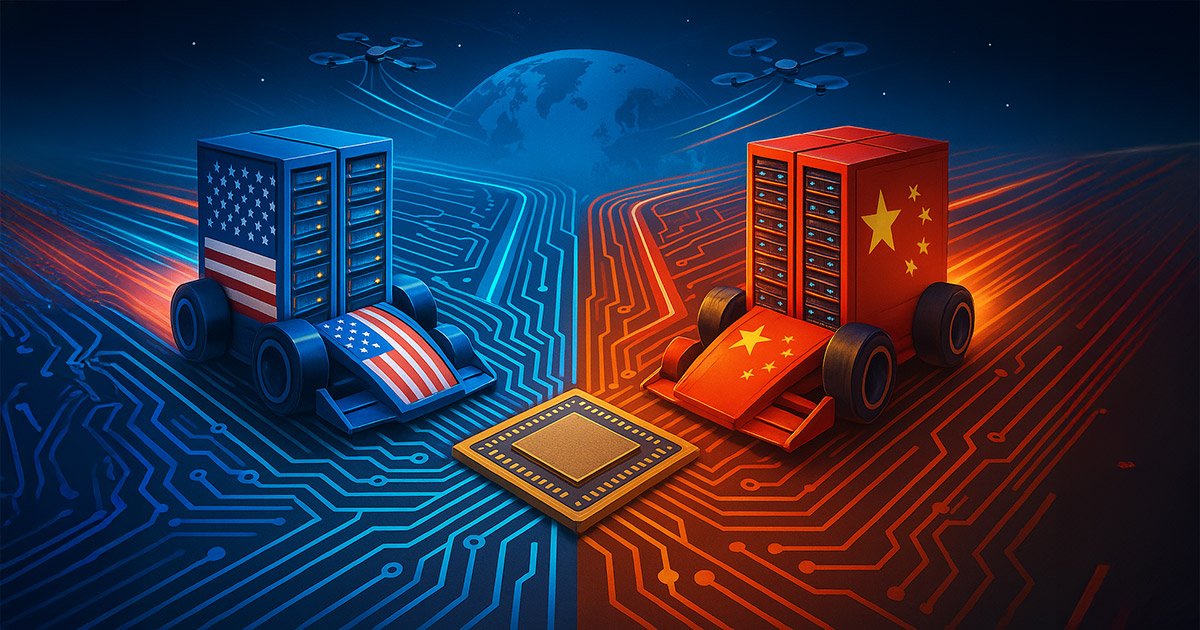
There’s an awful lot of hype surrounding AI, and even more capital behind it. AI data centers are propping up the U.S economy right now, accounting for over 1% of GDP. So when someone suggests the race may not be being won, or worse, that the AI race may be over, it makes people sit up in their seats.
But how much truth is there to this narrative, and are things really so black and white?
Some analysts say China aims to reach 65 gigawatts of nuclear capacity by the end of this year and 200 gigawatts by 2040 (roughly a tenfold growth).
By contrast, the U.S. completed its Vogtle 3 and 4 reactors after lengthy delays and cost overruns. Currently, there are no brand-new large-scale nuclear projects at the ground-breaking stage.
However, regulatory hurdles, public skepticism, and the sheer complexity of nuclear buildouts mean execution is far from guaranteed, and actual new construction is not yet underway.
Livingston poses an important question: Are we underestimating the role of pure energy in AI progress? Model training and inference have become ravenous for electricity.
Global data center energy consumption hit 415 terawatt-hours in 2024, forecast to double by 2030, with AI accounting for a growing share. So, in theory, nations that can deploy the most steady, carbon-free power will indeed have an advantage in the AI race.
China’s approach to industrial policy is direct, top-down, and aggressive. It has allowed it to ramp up nuclear construction rapidly, whereas American utilities have relied more on upgrades, license extensions, and slow, market-based activity.
Has “the funeral already happened,” as Livingston claims? The answer seems less definitive. China’s nuclear expansion is real and impressive, and its linkage to AI infrastructure is not far-fetched. AI does critically depend on continuous, affordable power.
However, U.S. leaders and companies are not exactly standing still. New projects, policy moves, and increased investment in both energy and AI are picking up, but so far, they are not matching China’s scale or speed.
The American advantage in foundational AI research, chip design, cloud infrastructure, and venture funding remains significant. Even if data-center power becomes a constraint, innovation in efficiency, smart grids, and distributed computation could narrow the gap.
Notably, “energy wars” may become as important as software or data, but the outcome will depend on much more than the number of nuclear plants alone. Livingston’s arguments highlight an overlooked aspect of the global tech struggle, but declare the funeral premature. The scoreboard is changing, but the AI race isn’t over yet.