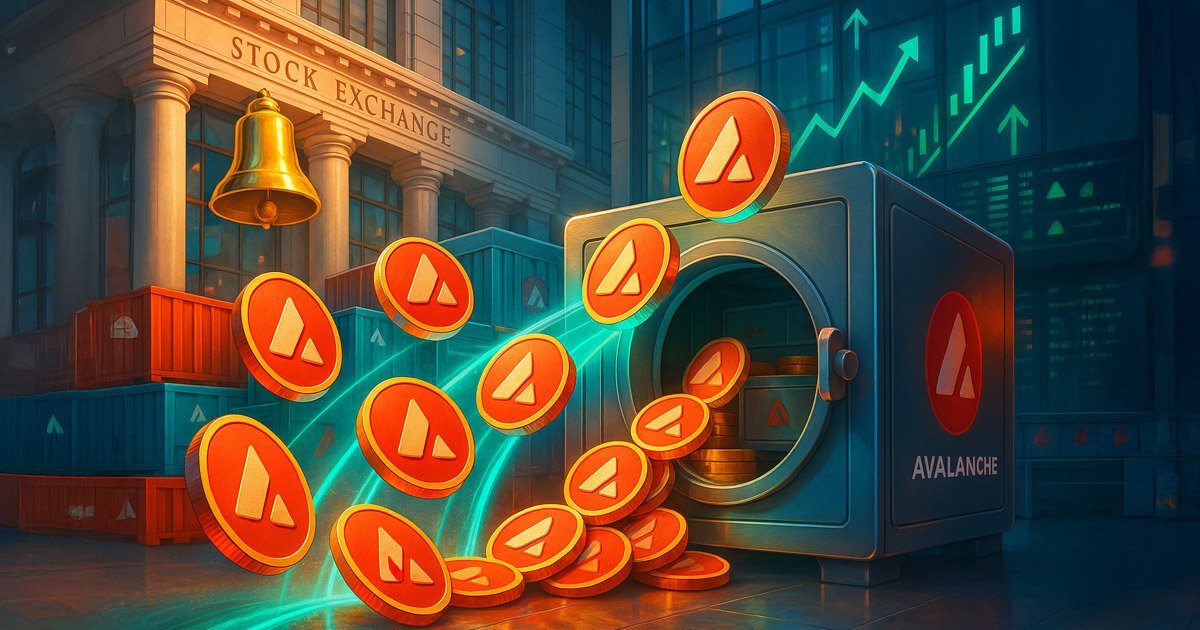
AgriFORCE said it will rebrand to “AVAX One” and accumulate roughly $700 million of AVAX. Meanwhile, Avalanche Treasury Co. (AVAT) unveiled a $675 million SPAC deal that seeds about $460 million in balance sheet assets and sets a goal to surpass $1 billion of AVAX after listing.
However, the token reversed to close at $33.49, up about 14% on the day. The movement extended to $36.16 in the first hours of Sept. 23, its first print above $36 since Jan. 31.
AVAX’s strength contrasted with a $30 billion drawdown in the altcoin market cap the same day, suggesting the announcement supported the performance.
Meanwhile, AgriFORCE’s stock (AGRI) spiked more than 200% intraday on Sept. 22, though it corrected 35% since and traded at $3.74 as of press time.
The AVAX-buying push mirrors the broader 2025 rise of DAT companies that first gained traction buying altcoins, such as Ethereum and Solana.
As the year progressed, BitMine and SharpLink accelerated their acquisitions, with their ETH balances climbing to 2.65 million ETH and 838,730 ETH, respectively, as of Oct. 2.
Ethereum’s price experienced a much-needed rebound and outperformed throughout the summer. ETH grew nearly 50% in July alone, then set a new all-time high of $4,956.78 on Aug. 24, almost four years after its previous price peak.
Additionally, US-traded spot Ethereum exchange-traded funds (ETFs) experienced a surge in inflows.
Ethereum ETFs then compensated for the time it took to capture massive inflows, and skyrocketed to nearly $14 billion in cumulative flows by Sept. 19, a 342% growth.
Solana is another major-cap crypto that saw significant interest in the DAT wave. Policy shifts and capital raises by SOL Strategies, DeFi Development Corp., and Upexi culminated in SOL breaching the $200 price level in July, the first time since February.
As the mentioned companies built DAT momentum and fueled SOL to a price peak of $218 by August, Forward Industries ramped up the tone.
Furthermore, as happened with Ethereum, the US-traded Solana ETF, which emulates spot exposure, also saw an increase in inflows.
Together, these precedents form the playbook AVAX treasuries can now follow, pairing large public market capital infusions with direct token accumulation, then catalyzing secondary vehicles and ecosystem activity.
AVAT is pitching a more integrated model than a simple “buy and hold.” The company stated that it secured an initial AVAX purchase at a discount to market and an 18-month priority window for Avalanche Foundation sales to US Treasury firms.
It also offered entry at approximately a 23% discount to direct token exposure (mNAV) and a mandate to deploy capital into Avalanche’s rails.
The mandate includes protocol investments that drive transactions, enterprise partnerships for real-world assets, stablecoins and payments, and validator support for institutional layer-1 launches.
CEO Bart Smith said:
“We created Avalanche Treasury Co. to offer something we believe will be more valuable than passive exposure.”
“The tokenization of assets is the single biggest theme for the next decade of finance.”
Hivemind’s Matt Zhang added the strategic ambition of building the “Berkshire Hathaway of the on-chain financial economy,” providing Wall Street with a scalable path into institutional-grade blockchain infrastructure.
For retail investors, the structures open two potential channels, followed by two categories of risk.
The first is secondary shares of the treasury companies themselves, where AVAT, for example, advertises access at an implied discount to its underlying token basket.
That “secondary discount” can be attractive but is not guaranteed, and can swing with sentiment, liquidity, and the cadence of new issuance.
The second channel is indirect, as DATs concentrate capital in AVAX and may amplify price discovery, improve depth across spot and derivatives venues, and accelerate the build-out of on-chain applications that create real transaction demand.
Yet the same PIPE mechanics that fund treasuries can hurt existing shareholders when resale windows open.
The dynamic creates an “overhang” that can pressure both the stocks and, indirectly, the underlying token when companies are forced to manage liquidity during periods of drawdown.
If the AVAX treasuries execute, the implications extend beyond the headline price.
A billion-dollar balance sheet buyer can legitimize AVAX alongside ETH and SOL in institutional policy frameworks, broaden the universe of allocators beyond crypto-native funds, and speed the emergence of AVAX-linked structured products.
Additionally, it sets the stage for deeper liquidity, more venues for regulated exposure, and a stronger case for the asset’s role in tokenized finance.