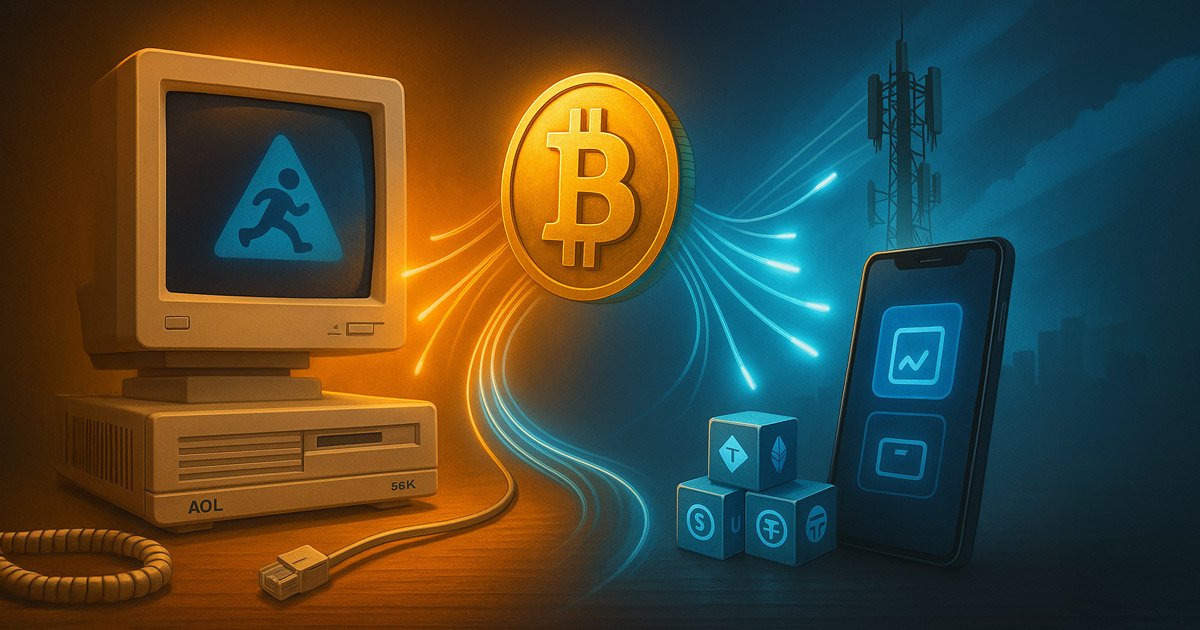
AOL discontinued dial-up internet access yesterday, Sept. 30, 2025, ending the access service while AOL Mail and other products remain.
The dial-up analogy surfaces whenever markets rotate or infrastructure sunsets, yet dial-up was an access modality to a network, not the network itself.
So, in short, no, Bitcoin is not going to be replaced like dial-up has been.
If there is a parallel to AOL in crypto, it is the set of custodial front ends, exchange on-ramps, and second-layer user experiences that rotate as technology and regulation move.
The network that dial-up connected to, the Internet, persisted and scaled across broadband and mobile generations.
The proper crypto mapping treats ETFs, stablecoins, and Layer-2s as access rails that can broaden participation, not as replacements for the base monetary layer.
Dial-up’s remaining footprint offers a perspective on sunset dynamics.
The 2023 American Community Survey counted about 163,401 U.S. households reporting dial-up alone, a heavily rural slice that persisted because of last-mile constraints and price sensitivity.
Crypto’s access mix looks similar in principle, with direct self-custody, exchange custody, programmatic exposure through ETFs, and emerging account-abstraction models all serving the same monetary protocol.
Spot Bitcoin ETFs in the United States have created a broadband-like on-ramp for institutions and advisors, converting operational hurdles into ticker exposure in brokerage accounts.
The ETF channel does not replace Bitcoin; it replaces operational friction in the way dial-up once gave way to cable, fiber, and 4G, all serving the same Internet.
Macro provides the cycle’s backdrop. On Sept. 17, the Federal Reserve cut the target range by 25 basis points to 4.00 to 4.25 percent, with officials emphasizing a cautious path that leaves optionality if inflation stalls above target.
Inflows into listed products tend to build when real yields stabilize and credit spreads stay orderly, so allocation channels rather than base-layer throughput often set the incremental marginal buyer for Bitcoin in this phase of the cycle.
On-chain activity often diverges from price and AUM, with Glassnode documenting that active address counts remain below 2021 highs even as capital access has broadened through ETFs, a gap consistent with a savings-led cycle rather than a payments-led one.
The replacement question is better tested as a set of vectors rather than a slogan. One path is monetary substitution in payments, where stablecoins or future CBDCs dominate transactions while Bitcoin concentrates as a savings instrument.
A second is functional abstraction, where layers and custodial accounts mask base-layer complexity much as broadband masked copper and modems for Web users. A third is competition from other L1s in payment or compute niches, which does not automatically dislodge Bitcoin’s store-of-value role if institutional rails and custody continue to harden.
Each path is observable with data, including ETP flows, wallet counts, stablecoin settlement, and layer capacity. Per Farside and CoinShares, the capital rail is the clearest change so far.
Policy remains the swing factor, including stablecoin legislation, bank connectivity, and ETP rule adjustments that could slow flows even if demand is intact.
Macro can reprice allocations quickly if inflation stalls above target or re-accelerates, which would pressure the Fed’s easing path and lift real yields, a setup that historically cools inflows into long-duration risk. Network structure deserves monitoring, especially pool concentration.
Execution risk shows up in Lightning routing concentration and channel management, which should be assessed next to growth in off-channel and custodial usage rather than read as a singular demand gauge.
Allocation and penetration scenarios frame 2026 to 2030 without resorting to price targets. A conservative path assumes about 0.5 percent allocation from global investable assets into Bitcoin across ETFs, corporate treasuries, and HNW custody, yielding hundreds of billions of potential demand over a full cycle, with choppy pacing if inflation surprises.
A base case uses a one percent allocation that, over time, creates a trillion-plus demand capacity if custody, clearing, and advisory workflows keep integrating Bitcoin.
An aspirational case in the two to two and a half percent range requires benign macro, scalable market plumbing, and clear policy, which would be equivalent to multi-trillion dollar capacity over the cycle.
On the user side, slow, base, and fast tracks range from about one billion to more than two billion crypto owners by 2030, depending on mobile wallet integrations, regulatory clarity, and the split between savings and payments.
The ITU baseline helps position those ranges on the adoption curve, since the world’s Internet penetration already sits near the upper half of the S-curve.
Framed this way, the end of dial-up clarifies the debate.
Access layers come and go as distribution, regulation, and user experience improve, while the network or monetary base can endure.
ETFs, stablecoins, and Layer-2s operate like broadband for capital and transactions, expanding the addressable base for savings and settlement without requiring a replacement for Bitcoin itself.
AOL’s original dial-up service is off, but the Internet is still on.