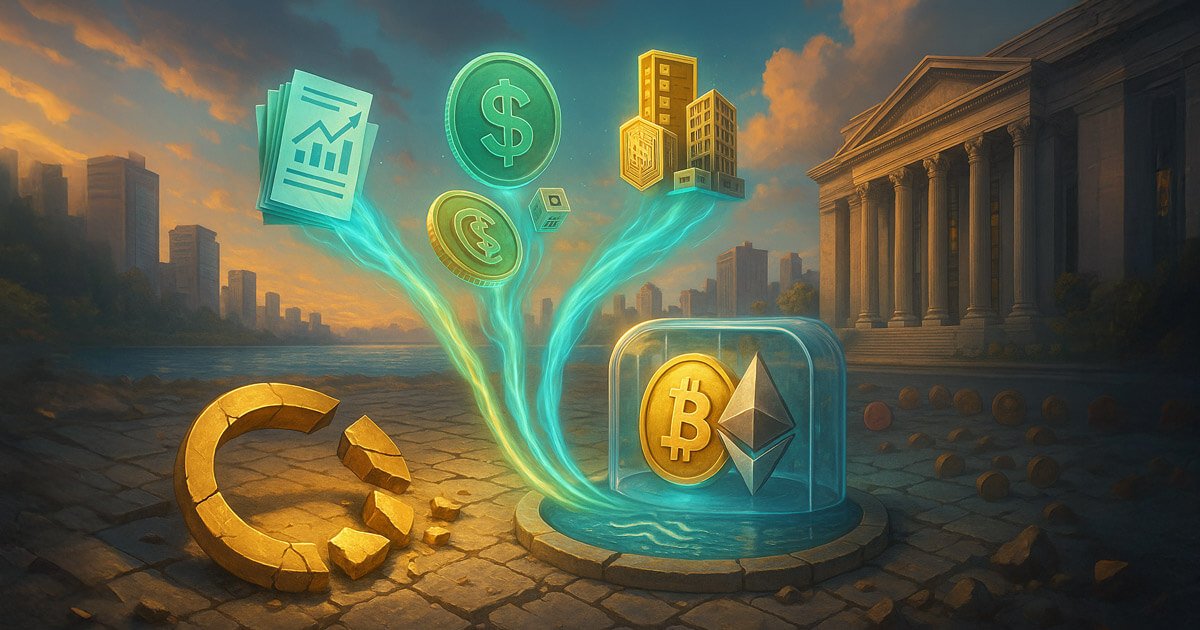
The traditional four-year crypto cycle appears to be broken, as institutional adoption through exchange-traded funds, real-world asset tokenization, and stablecoin infrastructure reshapes market conditions.
The products attracted pension funds, advisors, and banks, shifting crypto from retail speculation to institutional portfolios alongside gold and Nasdaq holdings.
Bitcoin ETFs now hold over $150 billion in assets under management, representing 6% of the total supply, while Ethereum ETFs control 5.6% of the ETH supply.
The report identified this transition as “The Great Crypto Rotation,” where ownership shifts from retail speculators to long-term institutional allocators.
Traditional four-year cycle believers sell while institutions accumulate, resetting cost bases higher and establishing new price floors. ETFs now serve as primary buyers for Bitcoin and Ethereum, fundamentally altering supply conditions that historically drove cyclical patterns.
Stablecoins have evolved beyond serving as trading tools to encompass payments, lending, and treasury functions.
The report mentioned the $30 billion real-world asset market as a demonstration of this expansion, with tokenized treasuries, credit, and commodities creating on-chain financial infrastructure.
This development provides crypto credibility while reducing direct correlation to Bitcoin and Ethereum spot demand.
At the same time, digital asset treasury (DAT) companies provide access to the equity market for tokens that lack ETF approval. These structures enable projects with genuine revenue and users to tap equity markets that are significantly larger than retail crypto capital.
The mechanism provides exit liquidity for venture capital positions while bringing institutional capital to altcoin markets.
As a result, decentralized finance protocols gain relevance beyond speculative loops through legitimate collateral and lending markets.
This structural transformation suggests that crypto’s evolution is shifting from cyclical speculation to a permanent financial infrastructure.
Yet, selective token performance will likely replace broad market rallies as institutional capital demands sustainable business models over pure narrative-driven appreciation.