The following is a guest post and analysis from Shane Neagle, Editor In Chief fromThe Tokenist.
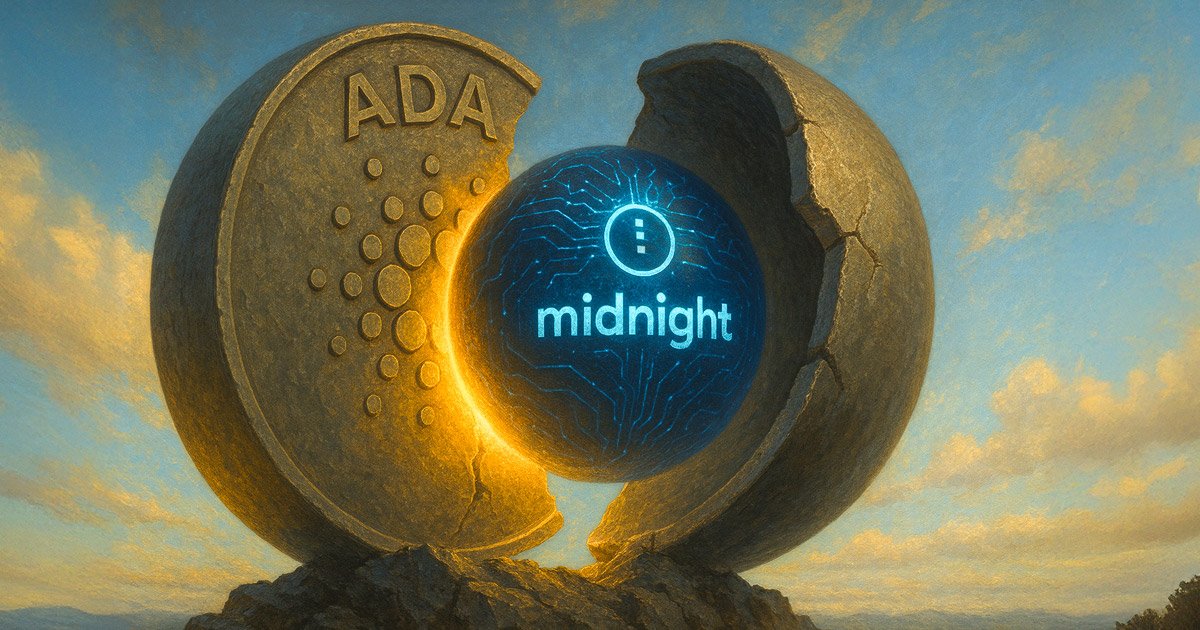
On June 23rd, Midnight Foundation released its first tokenomics paper. Earlier in June, Charles Hoskinson, the co-founder of Ethereum (ETH) and founder of Cardano (ADA), pegged Midnight as “the single biggest event in the history of Cardano,” with a caveat: “if it is successful.”
In that light, what is the merit behind Midnight?
It is no secret that the Cardano blockchain is generally perceived as lagging behind other networks such as Ethereum or Solana. By total value locked (TVL), Cardano ranks 20th according to DefiLlama, with $360 million in capital across ~50 dApps. For comparison, Solana has a TVL of $10 billion across ~240 dApps, which is again 8x lower than Ethereum.
This lack of significant market share is largely attributed to Cardano’s robust academic approach to smart contract development and blockchain frameworks, ensuring that the network has all its ducks in a row to avoid reputation-disabling vulnerabilities down the line.
Charles Hoskinson also noted the lack of stablecoins as a contributing factor, having floated the idea of converting around $100 million worth of ADA tokens into USDM stablecoins, which are issued by the regulated Moneta Digital LLC service.
Midnight is closely tied to Cardano’s IOHK (Input Output Hong Kong), later rebranded as Input Output Global (IOG). While the Swiss-based Cardano Foundation is in charge of developing the blockchain ecosystem, such as adoption and community-building, IOG is the software engineering organization behind Cardano’s core tech and roadmap.
As the current president of the Midnight Foundation launched in May, Fahmi Syed served within IOG to push the project, in addition to contributing to Polkadot and Kusama via Parity Technologies. Prior to Syed’s crypto involvement, he was the chief operating officer (COO) at UK-based Fifthdelta, which emerged as a startup from Citadel money managers in 2021.
Midnight Foundation pitches the network as a “fourth-generation blockchain built for secure, compliant, and private decentralised applications.” What does that mean exactly?
Specifically, Midnight Network uses ZK-SNARKs (Zero-Knowledge Succinct Non-Interactive Arguments of Knowledge) with its own smart contract programming language, Compact. Although zero-knowledge proof is more computationally intensive off-chain, this tech reduces on-chain load without requiring a trusted setup (depending on the variant used).
Per transaction, this approach exerts higher fees due to higher computational costs, but ZK-rollups turn this around by bundling many transactions into a single cryptographic proof. Ultimately, this reduces on-chain load and transaction costs.
In short, the purpose of Midnight is to act as a bridge between private and public ledgers, eliminating the exposure of on-chain transactions. The key to furthering that goal is Midnight’s Zswap ledger, which facilitates atomic token swaps.
At press time, Midnight listed 52 dApps across infrastructure, DAO, DeFi, wallets, NFTs, prediction markets, gaming, AI, and other areas that benefit from programmable privacy. As with many other crypto projects, Midnight is unrolling two types of tokens:
This supply is hard-capped, which means greater demand for transactions will not expand it. Under the umbrella of Midnight Foundation, the subsidiary Midnight TGE is in charge of this tokenomics model, in addition to Treasury and Reserve.
Reserve serves to issue NIGHT tokens to the network’s block producers, marking them as uncirculated supply.
Dubbed “Glacier Drop” for phase 1 rollout, the airdrop will run from July through August, delivering 50% (12 billion NIGHT tokens) to Cardano (ADA), 20% to Bitcoin (BTC), and 30% across Ethereum (ETH), Ripple (XRP), Solana (SOL), Avalanche (AVAX), BNB Chain (BNB), and Brave (BAT).
Every three months, 25% of NIGHT token supply is unlocked, with the total unlock reached after 360 days. Initially, NIGHT tokens are locked, becoming tradable gradually to avoid supply shocks. To encourage adoption, any crypto holders with a minimum of $100 across the aforementioned chains are eligible to claim NIGHT tokens.
Features such as atomic swaps, privacy, and cross-chain functionality have been pillars of the crypto space since the early days. Case in point: Komodo launched open-source AtomicDEX in mid-2019. However, Midnight Network appears to be a more comprehensive project by combining all three aspects.