


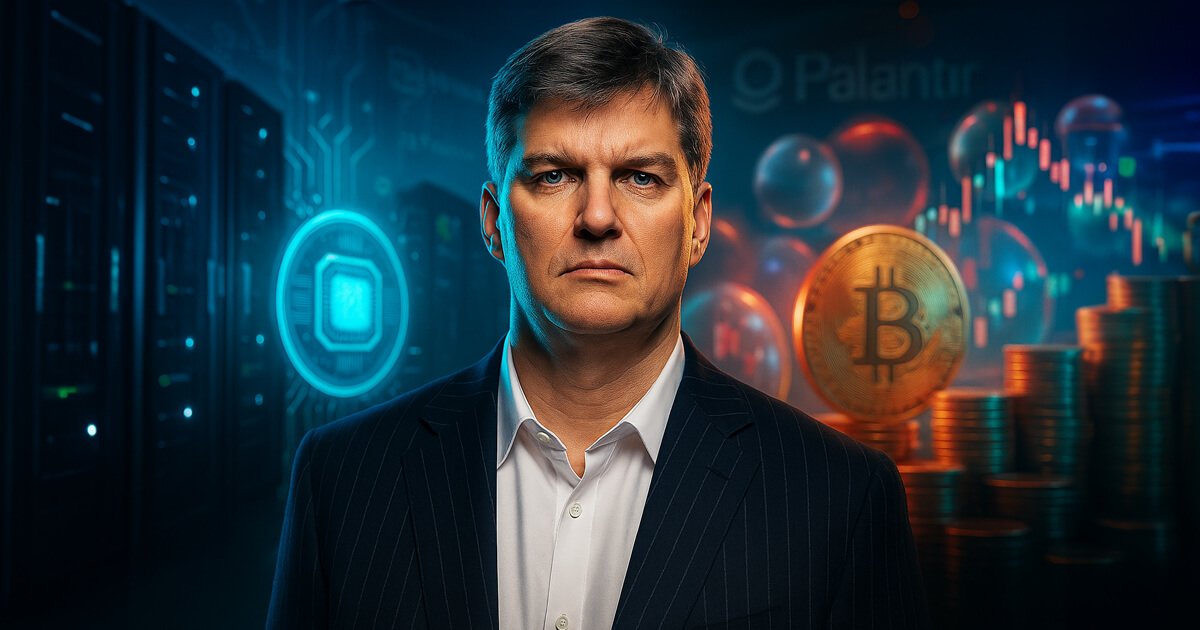
Michael Burry, the “Big Short” protagonist whose bet against the mortgage bubble made him a living legend, is back in the business of raining on parades. This time, instead of subprime debt, his sights are locked on Silicon Valley, specifically, the AI bubble he believes is about to pop.
Why is this important? Because when Michael Burry thinks there’s a bubble, people listen (if not for investment advice, at least for the entertainment value). After all, for every housing-market Cassandra, there’s a hundred Chicken Littles. But Burry is no stranger to calling out absurd market exuberance (and making bank while doing it).
“The two companies he’s shorting are the ones making all the money, which is super weird.”
He didn’t stop there, doubling down:
“The idea that chips and ontology is what you want to short is bats*** crazy… He’s actually putting a short on AI.”
Palantir’s numbers do back up a certain bravado. The company upgraded full-year revenue forecasts after a record Q3 and posted 173% gains over the last year.
Yet Wall Street’s obsession with AI is a double-edged sword, and even as Palantir beats forecasts, its share price can tumble 8–10% in a single breath, all thanks to valuation jitters and the swirling specter of “AI bubble trouble.”
As for Nvidia, CEO Jensen Huang had his own take, downplaying investor fears.
“China is going to win the AI race… we need to be in China to win their developers. A policy that causes America to lose half of the world’s AI developers is not beneficial in the long term; it hurts us more.”
Still, if you peek under the hood, Nvidia’s stock (which has soared more than 50% this year) slipped 3–4% intraday on November 4, on news of Burry’s short.
And some investors remain jittery, especially with looming U.S. chip export restrictions to China and the trillion-dollar question: Is momentum fueling monstrous valuations, or is it genuine demand?
“There are 2 US economies: Rich vs Poor, and AI is the lifeline of it all.”
Car repossessions are climbing. Wage growth is stalling. And Americans are carrying record levels of credit card debt, with interest rates hovering near historic peaks. Unless you count the influence of AI and data centers, America’s real economic growth is barely limping along, clocking in at just 0.01% according to Harvard economist Jason Furman.
Meanwhile, Wall Street’s top performers are running laps around Main Street, which is still struggling to catch its breath. The gap between winner-takes-all tech stocks and everyday households paints a pretty stark picture of today’s economy. If and when the AI bubble bursts, it’s going to hit like a Tyson left hook.
“The losses that will be suffered by Bitcoin HODLers and crypto investors will be staggering. More money will be lost in this bubble than was lost when the dot-com bubble popped. But if this signals an aversion to risk in general, look out for the even bigger AI bubble to burst.”
“Sometimes, we see bubbles. Sometimes, there is something to do about it. Sometimes, the only winning move is not to play.”
If the spectacle feels familiar, that’s because it is. In the dot-com era, pet-food websites with no earnings became household names, only to crash harder than a piano from a fourth-floor window.
Today, instead of dogs.com, it’s chips and data lakes; “chips and ontology,” as Karp jibes, with RSI readings above 70, price-to-earnings ratios exceeding 200 for Palantir, and price-to-book rocketing past 69. Nvidia and Palantir are riding a wave of profitability, but also expectations that would make a seasoned gambler sweat bullets.
CNBC reported Karp’s outrage, suggesting Burry’s actions were bordering on market manipulation as much as macro pessimism. He seethed:
“I think what is going on here is market manipulation. We delivered the best results anyone’s ever seen… I mean, these people, they claim to be ethical, but you know, they’re actually shorting one of the great businesses of the world.”
“Are we in a phase where investors as a whole are overexcited about AI? My opinion is yes. Is AI the most important thing to happen in a very long time? My opinion is also yes… When bubbles happen, smart people get overexcited about a kernel of truth.”
Still, he also argued that bubbles don’t kill revolutions, and sometimes they birth the next economy. Wall Street isn’t sure whether to clap or cringe. And Burry’s short has gotten them nervous.
Palantir, despite “otherworldly growth,” now has to deliver on 40–50% annual revenue expansion and 50% gross margins just to justify its price. The sector-wide rally is monumental, but a single tweet or earnings miss could knock out tens of billions in minutes.
Burry’s bearishness, Karp’s swagger, Huang’s angst; the AI bubble debate is a masterclass in financial melodrama. Are we witnessing history rhyming, or is tech simply flexing its muscles in a world desperate for new growth drivers?
If you trust Burry’s gut, there’s pain ahead. If you prefer your tech with a heaping side of chips (the silicon kind), maybe this is just the beginning. Karp insisted:
“I do think this behavior is egregious, and I’m gonna be dancing around when he’s proven wrong.”
Either way, bubbles are only obvious after they burst. Until then, thank Michael Burry for keeping the punch bowl spiked (and the market narrative anything but dull).






