


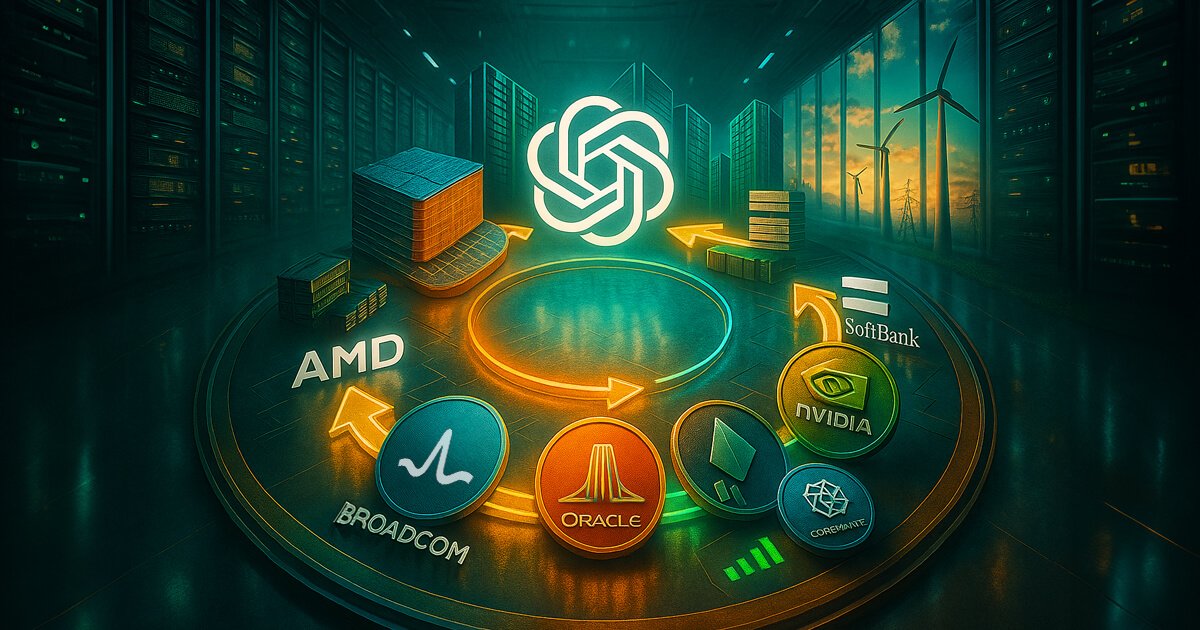
OpenAI has set in motion a $300 billion hardware expansion that binds its chip suppliers, financiers, and energy providers into a single feedback loop.
AMD will supply 6 gigawatts of Instinct GPUs and has granted OpenAI equity warrants tied to performance milestones, while Broadcom will co-design and deploy 10 gigawatts of custom silicon and rack systems over the same period.
The structure of these agreements points to a circular economy pattern in AI infrastructure where capital, equity incentives and purchase obligations interlock across vendors, infrastructure providers and model operators.
The AMD arrangement links future GPU deliveries to milestone-based warrants that give OpenAI upside exposure to AMD’s equity performance, creating a feedback loop between a supplier’s valuation and a customer’s capacity expansion path.
A forward-looking view turns on three execution gates: utilization, energy, and cost curves. On utilization, announced capacity ramps from AMD, Broadcom, and Stargate total well into the double-digit gigawatt range through 2029, while enterprise AI revenue must scale to keep cluster occupancy above threshold levels that support attractive returns.
Index concentration adds another macro channel, as the “Magnificent Seven” hovered near one third of S&P 500 market cap by mid-2025, which tightens passive portfolio sensitivity to AI news flow and capex guidance changes.
On energy, grid availability and delivered cost per megawatt-hour shape the feasible pace of model scaling.
McKinsey coverage cited across trade press places the U.S. trajectory at roughly 25 percent compound growth to 2030, with U.S. data centers potentially consuming more than 14 percent of national electricity by decade-end, which raises planning risk if interconnection queues and permitting timelines stretch relative to hardware deliveries.
Custom silicon is the cost lever to watch as Broadcom’s program moves from design to deployment.
If the accelerator, networking and rack co-design work delivers material performance per watt gains, inference cost of goods and training efficiency can reset the unit economics of the circular model toward self-funding cash flows as utilization builds.
Execution risk sits with toolchains, packaging and memory bandwidth, and the timeline begins in 2H26 with a multi-year ramp through 2029, so financial outcomes for vendors and operators will track the speed at which those gains appear in audited margins and contract pricing.
The immediate map of commitments is clear, and the conversion of framework deals into firm purchase orders, disclosed in vendor filings and press updates, is a near-term checkpoint.
CoreWeave’s financing and deal flow, including any corporate actions and the evolution of Nvidia’s ownership, will show how tight the loop becomes between supplier equity, infra capacity and OpenAI’s demand pathway.
The question for portfolio and treasury planning is how the announced gigawatts match realized workload growth, regional power deliverability and the cost trajectory through 2028. A practical way to track the shift from circular to sustainable is to pair data-center utilization metrics with energy contract coverage ratios and the mix of revenue from usage-linked enterprise agreements.
If those measures improve as 2H26 deployments begin, the financing loops embedded in these deals function as bridge capital to a steadier compute economy rather than as a source of correlation risk across vendors, infra providers, and the lab.
The forward path concentrates into a 24 to 36-month window when the first Broadcom systems and AMD waves come online, power contracts finalize at Stargate sites, and revenue-backed consumption ramps through enterprise channels. OpenAI says the Broadcom rollout finishes by the end of 2029.






