The move raises immediate compliance requirements for banks, payment firms, and crypto venues that could touch these actors through correspondent flows or dollar-linked stablecoins.
Sanctions block property and prohibit U.S. persons from dealings with designated entities, and they expose non-U.S. firms to secondary risk if transactions route through the United States.
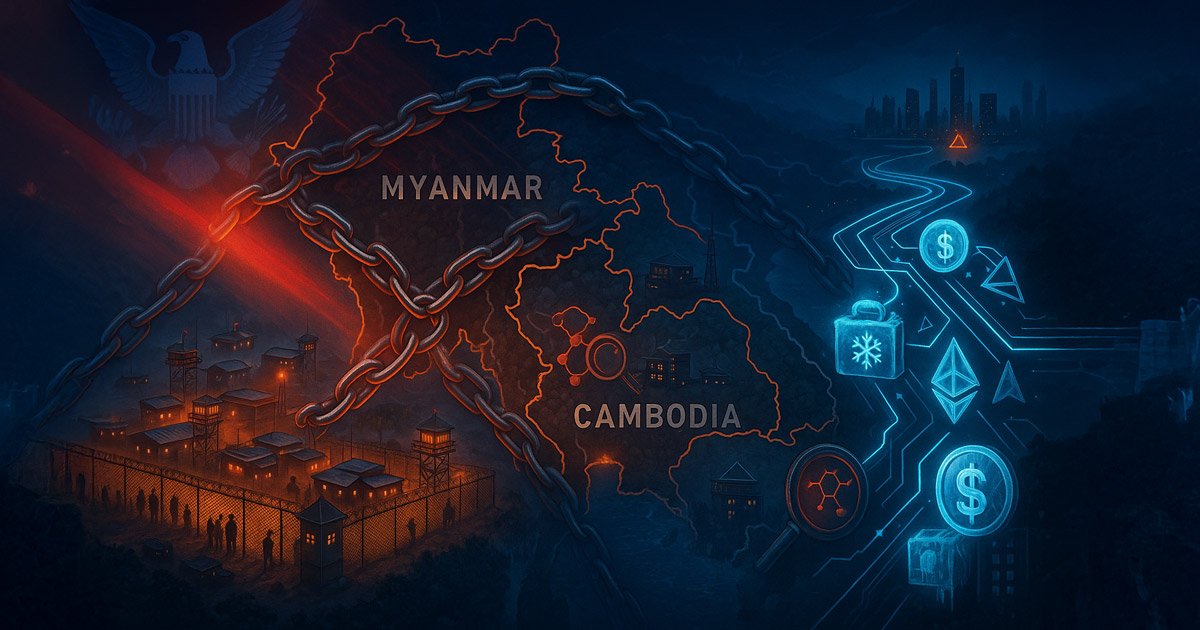
The entities are linked to compounds along the Thai-Myanmar border, including hubs around Shwe Kokko and Myawaddy that rely on trafficked labor. A United Nations Office on Drugs and Crime analysis estimates scam-compound profits near $40 billion annually, underscoring the scale of flows that can intersect with crypto rails.
That pattern implies compounding effects when designations coincide with exchange, issuer, and on-chain service enforcement, and weaker effects when enforcement gaps or extraterritorial limits persist.
If finalized, those measures would force additional Know-Your-Customer and transaction-monitoring steps for banks and processors handling payments linked to the network, adding friction to fiat on, and off-ramps even where crypto addresses rotate.
Risk-control priorities now shift to screening counterparties named in the latest designations and to tracing proximity exposure. Compliance teams should re-run SDN screening and ownership look-throughs under the 50 Percent Rule, cross-check any overlapping vendor or PSP relationships in Cambodia and Myanmar, and test on-chain address filters used for USDT redemptions and exchange deposits.
That posture, combined with FATF’s call for enhanced due diligence on Myanmar, raises the compliance bar for advertisers, payments, and messaging tools that intersect with scam recruitment and mule networks.
Near-term scenarios range from rapid de-risking by exchanges and stablecoin issuers that constrain redemptions tied to the named entities, to partial displacement into lesser-regulated venues and alt-rails with slower settlement.
Enforcement intensity at fiat off-ramps, Section 311 outcomes on enablers, and regional utility restrictions will determine how much value the compounds can extract.
Today’s designations place Myanmar’s Shwe Kokko-linked networks and their Cambodian counterparts under tighter scrutiny, and push more intermediary risk from on-chain services to off-chain firms with exposure to these nodes.