


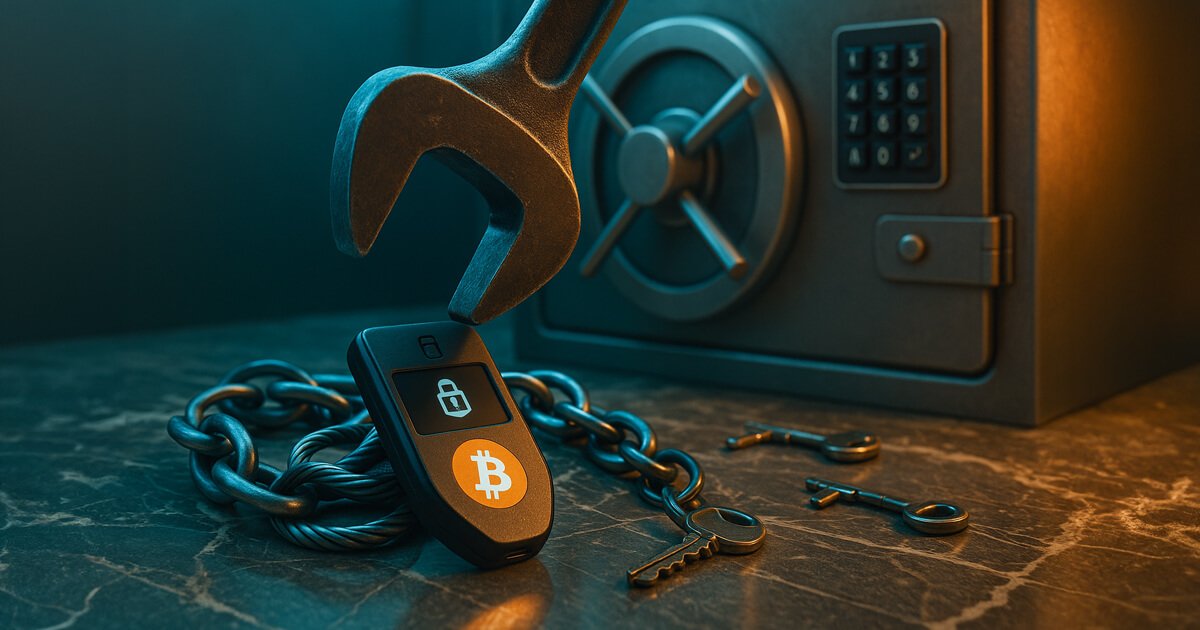
Self‑custody was once the ultimate badge of credibility in crypto. A declaration of faith in sovereignty over convenience, code over blind trust, and cryptography over legal fine print. But for many of the space’s earliest and wealthiest adopters, that belief is starting to bend under a different kind of pressure: wrench attacks.
In a world now flush with organized crime, doxxing, and $5 wrench attacks, even the most battle‑hardened Bitcoiners are locking away more than their coins; their ideology is going in the vault as well.
In late October 2025, Russian influencer Sergei Domogatskii was kidnapped in Bali by masked assailants who tased and beat him, forcing him to transfer approximately $4,600 in crypto from his mobile phone to their accounts. This is part of a rising trend of wrench attacks in this region, as Lopp previously told me:
“I’ve seen a number of attacks, for example, where Russian citizens who are either vacationing or living in Southeast Asia are getting hit by Russian organized crime. They’re coming into the country, wrench attacking them, and then trying to get out as quickly as possible, and presumably trying to leverage jurisdictional arbitrage.”
“I’m not self‑custodying anymore… I think you’ll see a lot more people who’ve been in this space a long time doing the same.”
Woo reinforced that smaller holders should absolutely keep control of their own coins, but large balances and public profiles create an entirely different threat model. It’s not about losing a hardware wallet anymore; it’s about personal safety.
They’ve split seed phrases and encrypted data across four continents. Family patriarch Didi Taihuttu said:
“Even if someone held me at gunpoint, I can’t give them more than what’s on my wallet or my phone. And that’s not a lot.”
Both Woo and Taihuttu were once among the poster children for full sovereignty. Their quiet retreat marks a broader sentiment shift (one now confirmed by the numbers).
Somehow, Wall Street has managed to do what few thought possible: lure long-time Bitcoin whales into its regulated fold. According to a recent Bloomberg article, a new breed of discreet, ultra-wealthy holders is quietly offloading their cold wallets and moving billions into spot ETFs (sometimes without so much as a murmur on the blockchain).
Thanks to “in-kind transfers,” these whales can dodge a taxable sale, swapping their BTC directly for ETF shares. BlackRock alone has taken in over $3 billion since July through this channel. Suddenly, what used to be a wild-west game of keys and ledgers is starting to look a lot more like traditional finance. All packaged up with a shiny ticker symbol and plenty of paperwork to go around.
Why? Because safety, reporting, and inheritance are finally trumping ideology.
“At high balances, the risk isn’t blockchain failure—it’s physical coercion and OPSEC drift (lost seeds, single-point wallets). 87% of families keep incomplete asset records, and 99.4% lack a verified digital twin of their holdings. Crypto often disappears at incapacity/death—not from volatility, but from missing credentials and unclear rights.”
For these families, ETFs and qualified custodians aren’t about giving in to TradFi. They’re about ensuring heirs can locate and transfer what might otherwise vanish.
Still, not everyone’s ready to hand the entire stack back to banks. There’s a rising class of “hybrid” custodians building bridges between full self‑sovereignty and institutional protection.
Seth for Privacy, vice president of the self‑custodial app Cake Wallet, says the wrench attacks problem doesn’t have to end self‑custody; it just forces it to evolve. He explains:
“Crypto has become mainstream, and self-custody solutions have to keep up.”
Beyond leveraging privacy tools, like Silent Payments and Payjoin, where possible, to keep their transactions out of public view, he believes the best protection for high‑profile individuals is to stop talking about their wealth.
That was a point hammered home by Lopp, as well, who told me:
“If you are on any sort of public network and you are flaunting your wealth, that’s one of the more risky things that you could be doing.”
Seth points to Lopp’s company, Casa, Unchained, or some newer entrants like Nunchuk and Liana as examples of “collaborative custody.” These setups enable users to maintain control while distributing risk through multi‑signature arrangements, such as a 2‑of‑3 or 3‑of‑5 scheme, with a fiduciary or geographically separate co‑signer to remove the single point of failure.
Anthony Yeung, chief commercial officer at CoinCover, also sees hybrid models as the pragmatic path forward.
“Complete independence also comes with risk. If a private key is lost or compromised, the assets are often gone forever. A hybrid model addresses this by combining the best of both worlds: individuals retain direct control and ownership of their assets, while a trusted institution provides a safety net through secure backup and recovery mechanisms.”
He calls this “a digital Fort Knox”: still user‑controlled, but institutionalized enough to enable secure backups, key recovery, and even inheritance triggers. Yeung adds:
“They may well be the bridge that brings the next generation of users from web2 to web3.”
Thomas Chen, CEO of Function and managing director at BitGo for six years, agrees, although he emphasizes personalization and risk tolerance.
“I think a future for hybrid models ultimately depends on the user’s risk profile and what they’re comfortable with.”
Those who self‑custody gain sovereignty but lose convenience, he says, particularly when they want to pledge assets as collateral, trade at scale, or interact with smart contracts in general. That’s not the experience that institutional investors want, and it may not be right for HNW individuals either. ETFs and custodial structures allow Bitcoin to act like a financial asset, not just a collectible. For institutions, that’s non‑negotiable. As Andrew Gibb, CEO of Twinstake institutional-grade, non-custodial staking platform, put it:
“The custody landscape is shifting from the crypto-native ideal of total self-control toward models that match the risk appetite and operational rigor of institutional investors.”
Fiduciary duty, in his view, forbids relying on untested personal key setups.
Yet not everyone’s convinced this convenience is worth the compromise. Tony Yazbeck, co‑founder of The Bitcoin Way, offers a sharper take:
“People love to overcomplicate this, but it really comes down to common sense. Some wealthy holders and institutions convince themselves they are safer putting their Bitcoin into ETFs or custodial accounts. They say it protects them from mistakes, inheritance issues, or even physical threats. In reality, it just hands control of the world’s scarcest asset to someone else and replaces ownership with paperwork.”
Having lived through Lebanon’s banking collapse, Yazbeck warns that history has proven that third parties fail, exchanges collapse, governments seize assets, and custodians freeze withdrawals. His advice is refreshingly non‑technical.
“The risk of losing your Bitcoin because you trusted a middleman is far higher than the risk of losing access to your own keys if you handle them properly. Multisig setups, secure backups, and simple operational discipline solve almost every real self-custody problem.”
But the best defense? Once again, stop attracting attention to yourself.
“Stay quiet about what you hold and live a normal life.”
His mantra: protect privacy, take responsibility, and never outsource what Bitcoin was invented to make trustless.
EY blockchain specialist Yaniv Sofer believes we’re witnessing a financial re‑tiering rather than an ideological rupture. He explains:
“Financial institutions are accelerating their entry into digital assets use cases, and custody is a critical core capability.”
While some firms buy access through third‑party providers like Fireblocks and BitGo, others build internal systems to integrate tokenization and payments. Sofer cautions:
“Hybrid custody models have not yet gained significant traction among financial institutions but remain a topic of interest. Regulatory requirements for qualified custodians continue to favor centralized solutions… but hybrid models could emerge as a differentiator as the market matures.”
In Avetisyan’s view, the long‑term equilibrium is clear. Most founders will run dual rails: core exposure in ETFs or qualified custody for reporting and collateralization, with a smaller self‑custody satellite for censorship resistance.
This dual-rail system, she says, is already shifting how liquidity flows through the crypto economy. As more Bitcoin migrates to custodial wrappers, traditional funding markets gain depth and stability. The flip side? Sovereignty becomes optional, not default.
Maybe what’s happening now isn’t so much an ideological defeat as a maturation. Bitcoin’s promise of self‑sovereignty remains intact for those who choose to uphold it. As the Bitcoin lead at Sygnum Bank, Pascal Eberle, comments:
“The future of “Freedom Money” lies in choice – investors can opt for full self-custody, institutional-grade protection, or hybrid models that balance both.”
Hybrid custody, institutional wrappers, and ETF liquidity are all symptoms of the same evolution: crypto crossing into the realm of structured finance.
For early believers, that can feel like a betrayal, with self-custody becoming sidelined to the margins. As Yazbeck framed it:
“Thinking you are safer by giving your Bitcoin to someone else is like a rich person surrounding themselves with a military convoy out of paranoia. It looks strong but it is actually weak.”
Yet perhaps this is decentralization in action; a dispersion of risk, trust, and control according to every individual’s appetite. Each generation of holder must redraw its own line between freedom and fear. In 2025, that line runs straight through the vault door.






