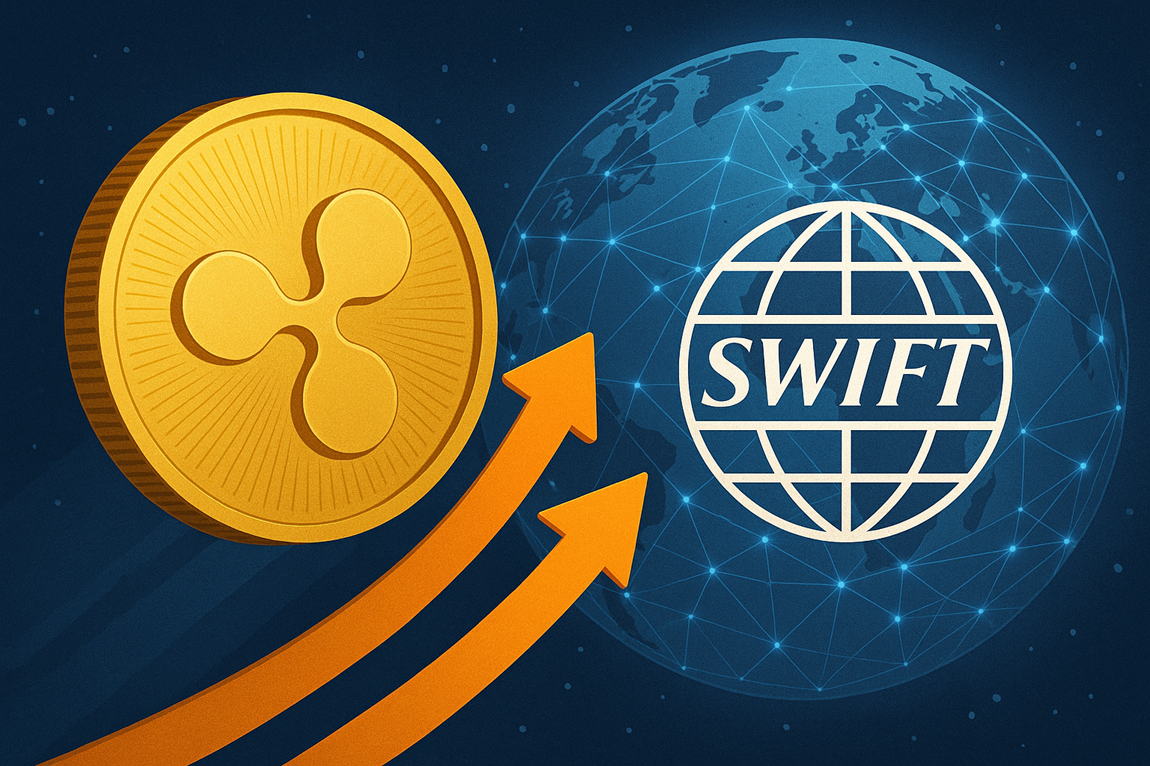
Ripple chief executive Brad Garlinghouse used XRPL Apex 2025 to set an audacious target for the company’s native asset. “If you’re driving all the liquidity, that’s good for XRP … so I’ll say five years, 14 percent,” he told the audience, distinguishing sharply between SWIFT’s well-known messaging layer and the liquidity rails that actually move money.
Garlinghouse’s forecast came during a dialogue with Ripple’s chief technologist David Schwartz, who framed the broader prize: “We’re going to see many, many hundreds of billions of dollars in tokenized … assets fairly quickly.” Schwartz argued that blockchains solve a mundane but stubborn problem in corporate audits—“How do you know I don’t owe somebody money that isn’t in the records you’re checking?”—and that this built-in transparency will accelerate adoption.
Quantifying Garlinghouse’s projection depends on which slice of SWIFT’s activity one counts. From the daily lens, industry data widely quoted in payments-technology literature shows SWIFT messages directing almost $5 trillion every 24 hours. Fourteen percent of that flow is roughly $700 billion per day—a value that could, under Ripple’s thesis, migrate to XRP-based liquidity rails.
From the annual payments lens and the cross-border payment traffic alone, SWIFT has been estimated to settle about $150 trillion a year. Fourteen percent of that narrower baseline would still amount to $21 trillion annually, more than the combined 2024 GDP of Japan and Germany.
Either yard-stick underscores the scale of the ambition: if XRP were to intermediate even the lower $21 trillion figure, its settlement throughput would eclipse that of most major national payment systems.
Ripple says its on-demand liquidity corridors processed “single-digit billions” last quarter; scaling to Garlinghouse’s target would therefore entail a two-order-of-magnitude jump.
At press time, XRP traded at $2.25.