A leading figure in the Bitcoin Ordinals movement has threatened to bankroll an alternative version of the reference Bitcoin software if Bitcoin Core tightens default relay policy to the detriment of Ordinals and Runes transactions. In an “open letter to Bitcoin Core” posted on September 6, Leonidas — host of The Ordinal Show and a prominent organizer in the inscriptions ecosystem — warned that “any serious attempt by Bitcoin Core to tighten policy rules or censor Ordinals and Runes transactions will be met with decisive action.”
Leonidas framed the dispute as one over the base-layer neutrality. He argued that the Ordinals/Runes economy is not freeloading, claiming it has “contributed over half a billion dollars in transaction fees to strengthen Bitcoin’s security,” and asserted he has spoken “directly with miners and mining pools representing more than 50% of Bitcoin’s total hash rate,” who, he said, will accept any consensus-valid transactions with competitive fees if the process is straightforward.
Bitcoin is not a finished product. We may be on a detour to address spam, and part of the crisis did originate with (mishandling of) the Segwit and Taproot upgrades – but to improve the world, we still need more functionality. Stopping all improvements forever (“ossifying”) is…
At the center of the dispute is Bitcoin Core v30, scheduled for October, and specifically a set of policy changes merged in June that widen the “standardness” aperture for data-carrying transactions.
Core v30 will remove the long-standing default 80-byte cap on OP_RETURN payloads (making the effective cap the block size limit) and, crucially, will begin relaying transactions with multiple OP_RETURN outputs by default — changes to mempool relay policy, not to consensus rules. Proponents say aligning policy with what miners actually include improves fee estimation, reduces reliance on out-of-band submission, and corrects perverse incentives that pushed data into the UTXO set; critics see it as normalizing non-monetary use of block space.
Core developers have publicly articulated where they draw the line. In a June 6 statement, signatories including Pieter Wuille, Gloria Zhao, Greg Sanders and others wrote that Core aims to “make our software work as efficiently and reliably as possible” for validating and relaying transactions and blocks, and that transaction-relay policy should not “block … transactions that have sustained economic demand and reliably make it into blocks.”
They warned that knowingly refusing to relay such transactions pushes users into alternative submission channels and undermines decentralization — while stressing this is not an endorsement of non-financial data, merely an acceptance that a censorship-resistant system will be used for things “not everyone agrees on.”
Leonidas, for his part, rejected any normalization of content-based filtering: “There is no meaningful difference between normalizing the censorship of JPEG or memecoin transactions and normalizing the censorship of certain monetary transactions by nation-states. Both would set very dangerous precedents.” He also claimed that “over twenty Bitcoin startups that operate economically relevant nodes … would welcome the expanded design space” if nodes were required only to follow consensus rules rather than “arbitrary policy restrictions.”
The governance backdrop matters. Bitcoin Core is not Bitcoin, and users choose which software to run — a point both sides invoke. In practical terms, the market is already voting with its node software: according to Coin.Dance, Knots has gained huge momentum and now accounts for 4,373 of 23,729 publicly reachable nodes — just over 18% — up sharply in recent months as the relay-policy fight has intensified.
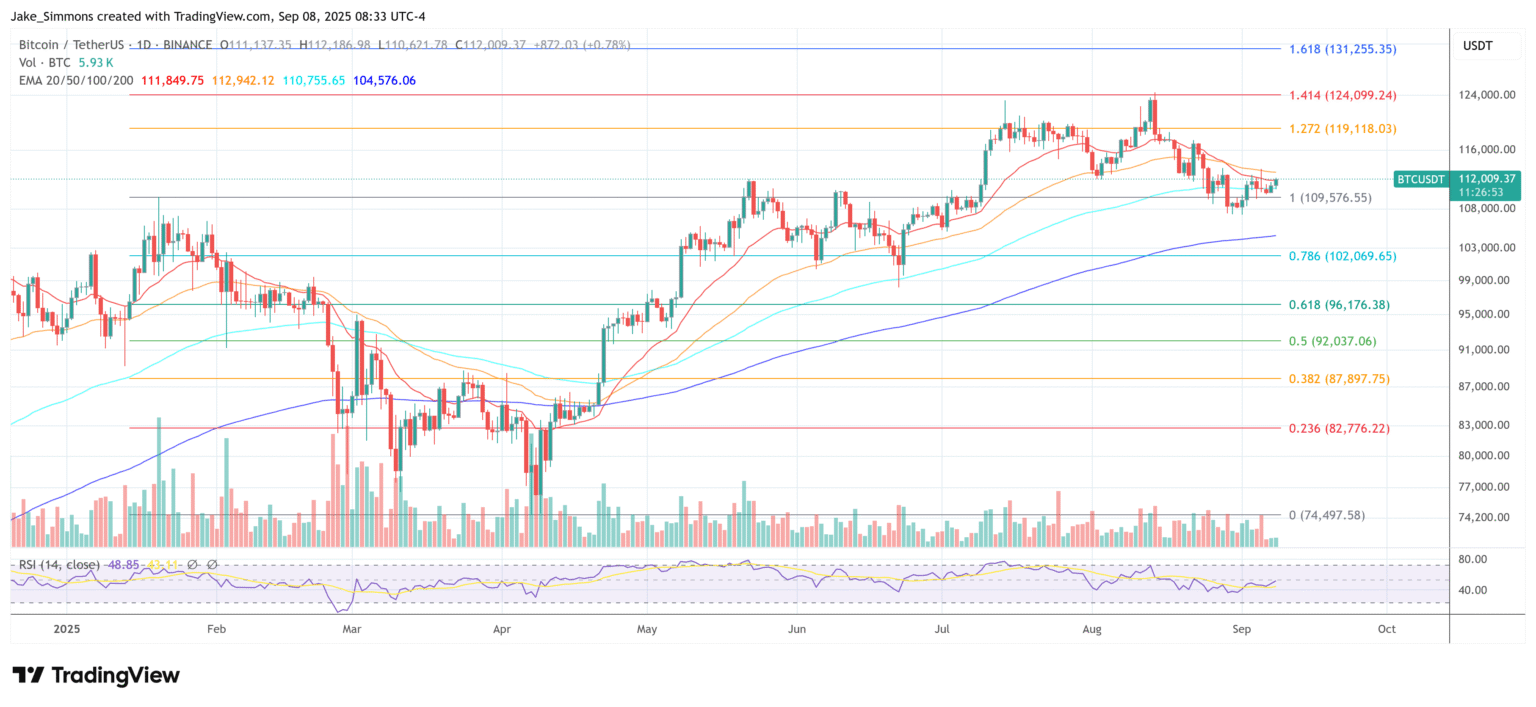
At press time, BTC traded at $112,009.