Navigating the Intersection of Policy, Automation, and Real-World Digital Infrastructure
Introduction: A Pivotal Era for Digital Assets
The cryptocurrency and blockchain technology ecosystems are undergoing a profound structural evolution. Moving beyond the speculative volatility of past cycles, the current landscape is defined by maturity, institutional adoption, and meaningful technological convergence. From major legislative updates in the United States to the seamless integration of artificial intelligence and real-world asset tokenization, digital asset technology is fundamentally reshaping global finance.
As traditional financial giants deepen their commitment to on-chain settlement, clear regulatory frameworks are replacing uncertainty, paving the way for sustained, long-term operational scaling.
Legislative Milestones and Regulatory Clarity
One of the most critical drivers of confidence in the crypto tech domain is the progress toward comprehensive regulatory frameworks. Historically, ambiguous rules created significant friction for builders, institutional investors, and traditional enterprises.
- The CLARITY Act: In the United States, advancing drafts of the CLARITY Act aim to establish a definitive market structure. By explicitly defining which government entities oversee specific classifications of digital assets, this legislation seeks to remove regulatory overlap between commodities and securities oversight.
- Stablecoin Oversight via the GENIUS Act: Concurrent initiatives like the GENIUS Act have accelerated bank-grade Know Your Customer (KYC) and operational compliance requirements for stablecoin issuers.
Rather than stifling development, these formalized guidelines offer legacy institutions the legal safety needed to deploy capital and integrate public blockchain rails into their core back-end operations. Globally, jurisdictions across Europe and Asia are similarly solidifying clear standards, transforming compliance from a bottleneck into a competitive advantage.
The Convergence of Artificial Intelligence and Blockchain
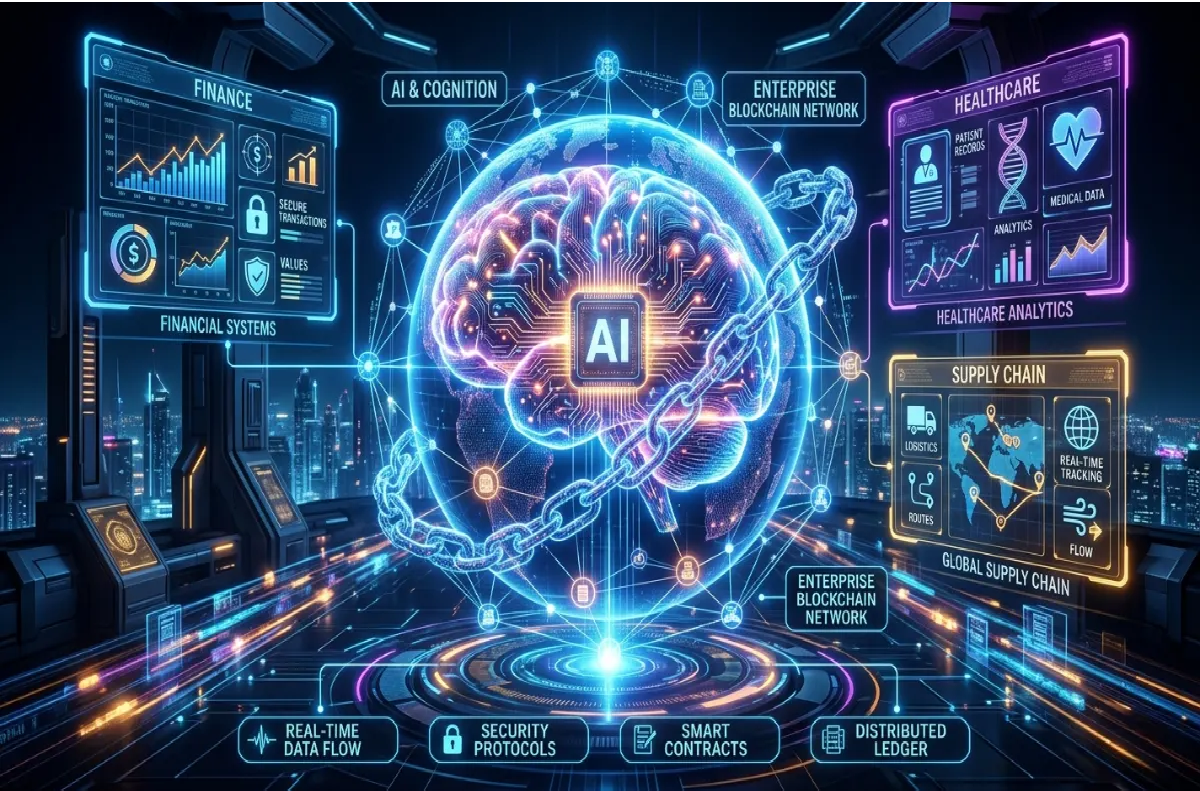
Artificial intelligence and decentralization are increasingly operating in tandem rather than in isolation. In 2026, the synergy between AI agents and blockchain rails represents one of the fastest-growing technical sectors.
Key Insight: Autonomous AI agents require open, programmable, and instantly verifiable payment rails to execute microtransactions without human intervention—a capability traditional banking APIs struggle to provide efficiently.
Protocols designed specifically for high-frequency, automated machine-to-machine microtransactions enable AI bots to independently manage portfolios, query decentralized storage, and pay for compute power on demand. Simultaneously, decentralized AI networks leverage blockchain consensus mechanisms to make machine learning models more transparent, auditable, and resistant to central points of failure or censorship.
Real-World Asset (RWA) Tokenization Takes Center Stage
While decentralized finance (DeFi) previously relied on crypto-native collateral, the industry is witnessing a massive pivot toward the tokenization of Real-World Assets (RWAs). Traditional asset classes—including sovereign government bonds, commercial real estate, private debt, and large-cap U.S. equities—are being converted into programmable digital tokens on-chain.
This paradigm shift offers several operational benefits over traditional financial rails:
- Fractional Ownership: Tokenizing high-value physical or financial assets allows investors to purchase micro-shares, drastically lowering the barrier to entry.
- 24/7 Liquidity and Instant Settlement: Unlike conventional stock exchanges operating within strict business hours, tokenized markets offer continuous, atomic settlement, eliminating settlement risks and reducing intermediary fees.
- Enhanced Capital Efficiency: On-chain assets can be seamlessly integrated into DeFi lending protocols as collateral, allowing investors to unlock liquidity without triggering taxable selling events.
Institutional giants like BlackRock, JPMorgan, and Citi have moved past pilot programs to launch live deposit tokens and tokenized fund products, demonstrating that blockchain is becoming the underlying infrastructure for future capital markets.
Next-Generation Infrastructure: Upgrades, Privacy, and Scalability
Beneath the user-facing applications, base-layer blockchain protocols are undergoing major technological overhauls to address historical challenges surrounding transaction throughput, privacy, and user experience.
- Protocol Enhancements: Major layer-1 networks are executing critical core upgrades aimed at drastically expanding base-layer capacity and lowering gas fees.
- Institutional Privacy Tech: To accommodate commercial transactions where exposing sensitive business logic on a public ledger is unacceptable, developer activity around Zero-Knowledge Proofs (ZKPs) and Fully Homomorphic Encryption (FHE) has surged. These cryptographic breakthroughs enable entities to verify data validity and execute private smart contracts without exposing transaction details publicly.
- Application-Specific Chains: The market is transitioning toward a “network-of-networks” architecture. Specialized chains tailored for specific use cases—such as gaming, enterprise logistics, or derivative trading—are interconnected via native, secure interoperability protocols.
Summary: The Road Ahead
The trajectory of crypto technology reflects an industry moving decisively toward real-world utility. As institutional investment frameworks—evidenced by mainstream benchmarks like the S&P Pantera Digital Asset Index—continue to mature alongside refined regulatory guidelines, blockchain systems are solidifying their position as the default rails for modern, programmable finance. While macroeconomic volatility and security threats persist, the underlying technological foundation is faster, safer, and more deeply integrated into global commerce than ever before.